If you sit for more than a few hours daily—and most of us do—your hip flexors are probably tight. These crucial muscles connect your spine to your legs, and when they’re shortened and stiff, problems cascade throughout your body. Here’s how to fix it.
Understanding Your Hip Flexors
What Are Hip Flexors?
The hip flexor group includes several muscles:
Iliopsoas: The primary hip flexor, connecting spine to femur Rectus femoris: Part of your quadriceps, crosses the hip Sartorius: The longest muscle in your body Tensor fasciae latae (TFL): Connects to your IT band
Together, they lift your knees, stabilize your pelvis, and allow you to bend at the waist.
Why They Get Tight
Prolonged sitting: Hip flexors remain shortened for hours Sedentary lifestyle: Lack of full range of motion Running/cycling: Repetitive flexion without extension Weak glutes: Hip flexors compensate for underactive glutes Poor posture: Anterior pelvic tilt keeps them contracted
Signs of Tight Hip Flexors
- Lower back pain (especially after sitting)
- Hip pain or stiffness
- Poor posture (excessive lower back arch)
- Limited stride when walking/running
- Knee pain
- Difficulty standing up straight after sitting
- Weak glutes or “dead butt syndrome”
The Best Hip Flexor Stretches
1. Kneeling Hip Flexor Stretch (Fundamental)
The classic stretch that everyone should know.
How to:
- Kneel on your right knee, left foot flat in front
- Keep your torso upright, core engaged
- Shift your weight forward while keeping your back straight
- Squeeze your right glute to deepen the stretch
- Hold 30-60 seconds, then switch sides
Pro tip: Don’t arch your lower back—tuck your pelvis slightly for a deeper stretch.
2. Couch Stretch (Intense)
The most effective hip flexor stretch, but also the most challenging.
How to:
- Place your right knee against a wall, shin vertical
- Step your left foot forward into a lunge position
- Squeeze your right glute and tuck your pelvis
- Gradually work toward upright torso
- Hold 60-120 seconds per side
Progression: Start away from the wall and move closer as flexibility improves.
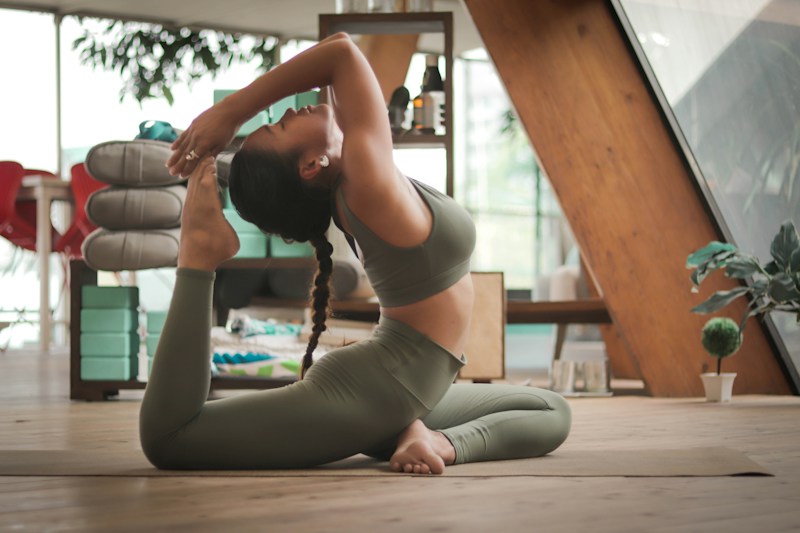
3. Pigeon Pose (Yoga Classic)
Opens hips while stretching hip flexors of the back leg.
How to:
- Start in a plank position
- Bring your right knee forward, placing it behind your right wrist
- Extend your left leg straight back
- Keep your hips square to the ground
- Fold forward if comfortable
- Hold 60-90 seconds per side
4. Standing Hip Flexor Stretch
Perfect for the office or when you can’t get on the floor.
How to:
- Stand in a staggered stance, right foot back
- Bend both knees slightly
- Tuck your pelvis (posterior tilt)
- Shift weight forward while keeping torso upright
- Reach your right arm overhead and lean slightly left
- Hold 30-45 seconds per side
5. Supine Hip Flexor Stretch
Gentle option that supports your lower back.
How to:
- Lie at the edge of a bed or bench
- Let your right leg hang off the edge
- Pull your left knee to your chest
- Let gravity stretch the right hip flexor
- Hold 60-90 seconds per side
Best for: Those with lower back sensitivity.
6. 90/90 Hip Stretch
Targets multiple hip muscles simultaneously.
How to:
- Sit with your front leg bent 90° in front of you
- Back leg bent 90° to your side
- Sit tall, then lean forward over your front leg
- Return upright, then rotate toward your back leg
- Hold each position 30-45 seconds
7. Lizard Pose (Deep Stretch)
Advanced stretch for those with good flexibility.
How to:
- From a lunge, place both hands inside your front foot
- Lower your back knee to the ground
- Let your front knee fall outward slightly
- Drop to your forearms if possible
- Hold 60-90 seconds per side
Dynamic Hip Flexor Exercises
Static stretching is great, but movement matters too.
Leg Swings
How to: Stand sideways to a wall, swing one leg forward and back in a controlled manner. 15-20 swings per leg.
Walking Lunges
How to: Step forward into a lunge, keeping your torso upright. Alternate legs for 10-15 steps.
Hip Circles
How to: Standing on one leg, draw large circles with your opposite knee. 10 circles each direction per leg.
World’s Greatest Stretch
How to:
- Step into a deep lunge
- Place both hands inside your front foot
- Rotate your torso, reaching one arm to the ceiling
- Return and repeat on other side
- 5-8 reps per side
Creating Your Routine
Quick Daily Routine (5 minutes)
Perform after sitting for extended periods:
- Kneeling hip flexor stretch - 30 sec each side
- Standing hip flexor stretch - 30 sec each side
- Leg swings - 15 each leg
Complete Hip Opening (15 minutes)
For dedicated mobility work:
- Dynamic leg swings - 2 minutes
- Kneeling hip flexor stretch - 60 sec each side
- Couch stretch - 90 sec each side
- Pigeon pose - 90 sec each side
- 90/90 stretch - 60 sec each position
Pre-Workout Hip Prep (3 minutes)
- Hip circles - 10 each direction
- Walking lunges - 10 steps
- World’s Greatest Stretch - 5 each side
Complementary Exercises
Stretching alone isn’t enough—strengthen what’s weak.
Glute Bridges
Activates glutes to balance hip flexor dominance.
How to: Lie on your back, feet flat, lift hips by squeezing glutes. 3 sets of 15.
Dead Bugs
Teaches core stability without hip flexor compensation.
How to: Lie on back, arms up, knees at 90°. Extend opposite arm and leg while keeping back flat. 3 sets of 10 each side.
Hip Airplanes
Improves hip mobility and stability simultaneously.
How to: Stand on one leg, hinge forward, rotate hips open then closed. 8-10 reps per leg.
Common Mistakes to Avoid
Arching your lower back: Keeps hip flexors from fully stretching. Tuck your pelvis instead.
Bouncing: Can cause injury. Hold stretches steadily.
Skipping warm-up: Cold muscles don’t stretch as well. Walk or move for 2-3 minutes first.
Inconsistency: Daily short sessions beat occasional long sessions.
Ignoring both sides: Even if one side feels tighter, stretch both equally.
When to Seek Help
See a professional if you experience:
- Sharp or shooting pain during stretches
- Pain that persists after stretching
- Numbness or tingling
- Limited improvement after 4-6 weeks of consistent work
- Pain that interferes with daily activities
Your Action Plan
Week 1-2: Daily 5-minute routine + awareness of sitting time Week 3-4: Add complete hip opening 2-3 times per week Ongoing: Maintain with daily quick stretches + weekly deep sessions
Conclusion
Tight hip flexors don’t have to be your reality. With consistent, targeted stretching and complementary strengthening, you can restore natural movement, reduce pain, and feel better in your body.
Start today. Even one stretch is better than none. Your hips—and your lower back—will thank you.
Remember: Flexibility improves gradually. Be patient with yourself, stay consistent, and celebrate small victories.